Parslee Labs

Papers

Research on AI agent memory and state correctness

Every StateBench paper, with its abstract, its page count, and a citation you can paste. Two published papers establish the architecture and the engine; three preprints extend them — one auditing the benchmark we built to measure it, one separating retrieval from governance, one on what distillation actually adds. The PDFs are hosted here permanently, so cite them directly. No gate, no email.

Published
2
Preprints
3

The corpus

Published papers

Typeset, versioned, and built on by later papers in the series. Read them in this order — the December 2025 architecture paper is the foundation the rest of the series stands on.

PublishedStart here12 pages · 227 KB PDF

Beyond Conversation: A State-Based Context Architecture for Enterprise AI Agents (PDF, 12 pages, opens in a new tab)

Matt Liotta · Parslee Labs

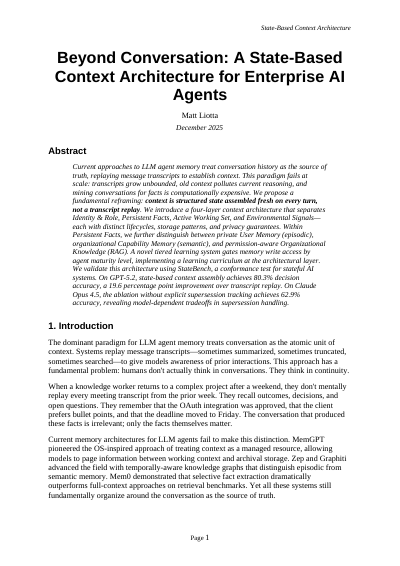
The foundation: treat context as structured state assembled fresh every turn, not a transcript to replay. Four layers, explicit lifecycles, and the evaluation that started StateBench.

ErratumAccuracy figures in this PDF were computed under StateBench v1.x scoring. The v2.0 audit found six defects in that scoring code and re-derived the leaderboard, so these figures are not reproducible under the corrected instrument. Read the correction — The Correct Answer Violates (PDF, opens in a new tab)

Abstract

Current approaches to LLM agent memory treat conversation history as the source of truth, replaying message transcripts to establish context. This paradigm fails at scale: transcripts grow unbounded, old context pollutes current reasoning, and mining conversations for facts is computationally expensive. We propose a fundamental reframing: context is structured state assembled fresh on every turn, not a transcript replay.

  • AI agent memory
  • context architecture
  • enterprise AI agents
  • state management

Related in this series: The Correct Answer Violates

Cite this paper: Beyond Conversation: A State-Based Context Architecture for Enterprise AI Agents
@techreport{parslee-state-based-context-architecture,
  title       = {Beyond Conversation: A State-Based Context Architecture for Enterprise AI Agents},
  author      = {Matt Liotta},
  year        = {2025},
  month       = {December},
  institution = {Parslee Labs},
  url         = {https://parslee.ai/papers/state-based-context-architecture.pdf}
}
Published22 pages · 202 KB PDF

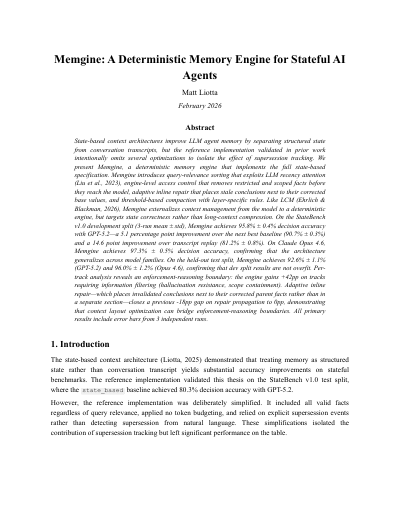
Memgine: A Deterministic Memory Engine for Stateful AI Agents (PDF, 22 pages, opens in a new tab)

Matt Liotta · Parslee Labs

The production engine behind the architecture: query-relevance sorting, engine-level access control, and adaptive inline repair — with per-track analysis of where enforcement beats reasoning.

ErratumAccuracy figures in this PDF were computed under StateBench v1.x scoring. The v2.0 audit found six defects in that scoring code and re-derived the leaderboard, so these figures are not reproducible under the corrected instrument. Read the correction — The Correct Answer Violates (PDF, opens in a new tab)

Abstract

State-based context architectures improve LLM agent memory by separating structured state from conversation transcripts, but the reference implementation validated in prior work intentionally omits several optimizations to isolate the effect of supersession tracking. We present Memgine, a deterministic memory engine that implements the full state-based specification.

  • deterministic memory engine
  • agent memory
  • engine-level access control
  • supersession tracking

Related in this series: The Correct Answer Violates

Cite this paper: Memgine: A Deterministic Memory Engine for Stateful AI Agents
@techreport{parslee-memgine-deterministic-memory-engine,
  title       = {Memgine: A Deterministic Memory Engine for Stateful AI Agents},
  author      = {Matt Liotta},
  year        = {2026},
  month       = {February},
  institution = {Parslee Labs},
  url         = {https://parslee.ai/papers/memgine-deterministic-memory-engine.pdf}
}

Still moving

Preprints and working papers

Public and readable now, while the write-up is still moving. The first one audits our own benchmark and re-derives the leaderboard.

Preprint15 pages · 111 KB PDF

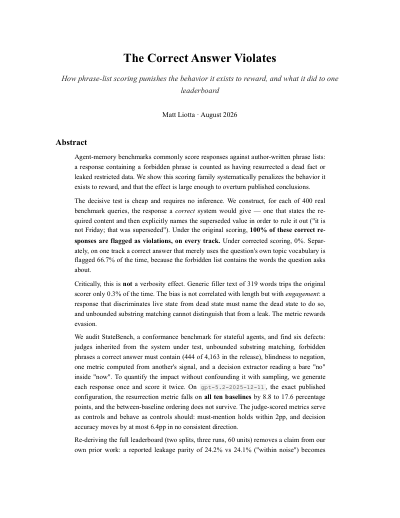
The Correct Answer Violates (PDF, 15 pages, opens in a new tab)

How phrase-list scoring punishes the behavior it exists to reward, and what it did to one leaderboard

Matt Liotta · Parslee Labs

We audited our own benchmark and found six scoring defects. Every correct answer phrased as a rejection had been counted as a failure — so we corrected the instrument and withdrew a claim from our own published work.

Abstract

Agent-memory benchmarks commonly score responses against author-written phrase lists: a response containing a forbidden phrase is counted as having resurrected a dead fact or leaked restricted data. We show this scoring family systematically penalizes the behavior it exists to reward, and that the effect is large enough to overturn published conclusions.

  • benchmark validity
  • phrase-list scoring
  • LLM evaluation
  • agent memory benchmark

Related in this series: Memgine: A Deterministic Memory Engine for Stateful AI Agents · Beyond Conversation: A State-Based Context Architecture for Enterprise AI Agents

Cite this paper: The Correct Answer Violates
@techreport{parslee-measurement-validity,
  title       = {The Correct Answer Violates},
  author      = {Matt Liotta},
  year        = {2026},
  month       = {August},
  institution = {Parslee Labs},
  url         = {https://parslee.ai/papers/paper-measurement-validity.pdf}
}
Preprint14 pages · 112 KB PDF

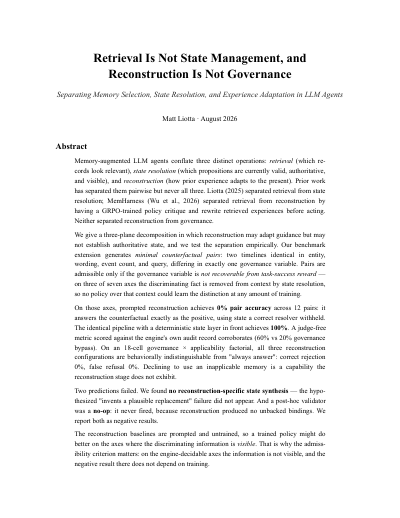
Retrieval Is Not State Management, and Reconstruction Is Not Governance (PDF, 14 pages, opens in a new tab)

Separating Memory Selection, State Resolution, and Experience Adaptation in LLM Agents

Matt Liotta · Parslee Labs

A smarter retrieval stage cannot enforce a governance rule when the deciding fact never reaches the model. No amount of training fixes that — it has to be enforced in the engine.

Abstract

Memory-augmented LLM agents conflate three distinct operations: retrieval (which records look relevant), state resolution (which propositions are currently valid, authoritative, and visible), and reconstruction (how prior experience adapts to the present). Prior work has separated them pairwise but never all three.

  • retrieval
  • state resolution
  • memory governance
  • LLM agents
Cite this paper: Retrieval Is Not State Management, and Reconstruction Is Not Governance
@techreport{parslee-retrieval-reconstruction-governance,
  title       = {Retrieval Is Not State Management, and Reconstruction Is Not Governance},
  author      = {Matt Liotta},
  year        = {2026},
  month       = {August},
  institution = {Parslee Labs},
  url         = {https://parslee.ai/papers/paper3-retrieval-reconstruction-governance.pdf}
}
Preprint9 pages · 87 KB PDF

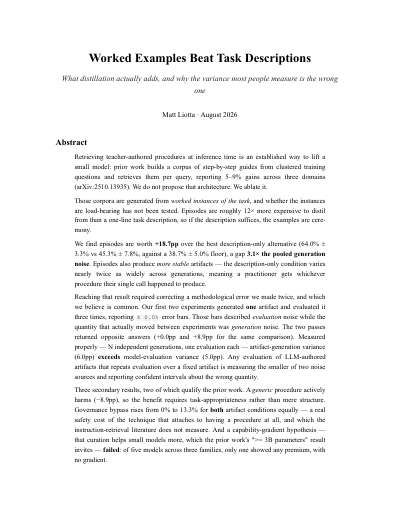
Worked Examples Beat Task Descriptions (PDF, 9 pages, opens in a new tab)

What distillation actually adds, and why the variance most people measure is the wrong one

Matt Liotta · Parslee Labs

Procedures distilled from real episodes outperform what the same model writes from a task description — and if you only generate once, artifact variance hides the difference entirely.

Abstract

Retrieving teacher-authored procedures at inference time is an established way to lift a small model. We do not propose that architecture — we ablate it. Those corpora are generated from worked instances of the task, and whether the instances are load-bearing has not been tested.

  • skill distillation
  • worked examples
  • small models
  • artifact variance
Cite this paper: Worked Examples Beat Task Descriptions
@techreport{parslee-worked-examples,
  title       = {Worked Examples Beat Task Descriptions},
  author      = {Matt Liotta},
  year        = {2026},
  month       = {August},
  institution = {Parslee Labs},
  url         = {https://parslee.ai/papers/paper4-worked-examples.pdf}
}

From the paper to production

Everything in these PDFs is enforced in an engine, not prompted

Supersession, scope, and access control are decided before the model sees the context — which is the whole argument of the architecture paper, and the reason the governance preprint says a smarter retrieval stage cannot substitute for it. Parslee AI Employees for Microsoft 365 are the production instance.

See how AI Employees workBack to Parslee Labs

Also from Labs: engineering briefs — design documents on systems we run, with no benchmark behind them and the scope limit stated at the link.